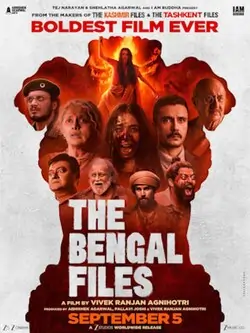
The Bengal Files is a 2025 Bollywood Hindi political drama and propaganda film, writer cum director is Vivek Agnihotri.
This film story Based on the Direct Action Day and the Noakhali riots, showing the violence and its aftermath as a genocide.
The film’s leading star cast are Darshan Kumar, Mithun Chakraborty, Anupam Kher, Pallavi Joshi, and Simrat Kaur.
The Bengal Files is the third and final novel of Agnihotri’s The Files Trilogy, which is centered on modern Indian history and follows The Tashkent Files (2019) and The Kashmir Files (2022). It was released on September 5, 2025, and is one of the longest Indian movies at 204 minutes. The movie was a commercial failure and was criticized for its historical inaccuracy.
Cast and Crew:
- Director: Vivek Agnihotri
- Writer: Vivek Agnihotri
- Producer: Abhishek Agarwal, Pallavi Joshi, Vivek Agnihotri
- Star Cast: Mithun Chakraborty, Pallavi Joshi, Darshan Kumar, Simrat Kaur, Anupam Kher, Saswata Chatterjee, Namashi Chakraborty, Puneet Issar, Sourav Das, Eklavya Sood
- Cinematography: Attar Singh Saini
- Editor: Shankh Rajadhyaksha
- Music Director: Rohit Sharma
- Production companies: Abhishek Agarwal Arts
- I Am Buddha Productions
- Genres: Drama, History
- Distributor: Zee Studios
- Release date: 5 September 2025
- Running time: 204 minutes
- Country: India
- Language: Hindi
The Bengal Files movie 2025 Trailer
Star Cast
- Mithun Chakraborty as Mad Man Chatur
- Pallavi Joshi as Maa Bharati
- Aged Bharti Banerjee
- Simrat Kaur as young Bharati Banerjee
- Darshan Kumar as Shiva Aloke Pandit, Special Investigating Officer, CBI
- Anupam Kher as Mahatma Gandhi
- Saswata Chatterjee as Sardar Husseini, MLA, Murshidabad
- Eklavya Sood as Amarjeet Arora “Amar”
- Namashi Chakraborty as Gholam Sarwar Husseini
- Rajesh Khera as Muhammad Ali Jinnah
- Puneet Issar as Rajnath Singh, Director, CBI
- Priyanshu Chatterjee as Justice Banerjee
- Dibyendu Bhattacharya as Rajendra Lal Roychowdhary
- Sourav Das as Gopal Patha
- Mohan Kapur as Suhrawardy
- Digvijay Purohit as Jawaharlal Nehru
- Jivraj Pipaliya as Sardar Patel
- Vinayak Miskin as Liaquat Ali Khan
- Richard Keep as Lord Mountbatten
- Emily R. Ackland as Edwina Mountbatten
- Raj Kanani as Sheikh Mujibur Rahman
- Anubha Arora as Gauri
- Dibanisha Banerjee as Gita Mandal
- Rumi Jaffery as Agha Jameel Kashmiri
- Madalsa Sharma as Sardar Husseini’s wife
- Ruma Mandal as Bharati’s mother
- Diksha Raina as Shiva’s mother
Story of the film
The plot opens in modern-day India with Shiv Pandit, a top Central Bureau of Investigation investigator, tasked with finding Gita Mukherjee, a journalist who went missing while conducting delicate historical research. Before going missing under strange circumstances in 1946, Geeta had been looking into historical records from Bengal. Pandit initially handles it as a standard missing-person case, but he soon discovers that several official documents of the journalist’s work have been destroyed, altered, or sealed. It becomes evident that significant interests are intentionally impeding the investigation, as those who were last in contact with Gita either refuse to talk or give conflicting statements.
Following the journalist’s trail, Pandit learns that the lost study concentrated on 1946 Bengali events, particularly the communal violence that broke out in Calcutta around Direct Action Day and subsequently extended to other areas. The story frequently switches to flashbacks that illustrate how growing political tensions between communities—fueled by colonial retreat and conflicting political demands—escalated into widespread riots, murders, and mass displacement. Confusion, panic, and a collapse of authority during that time are depicted through a variety of views, including those of survivors, victims, and people ensnared in political machinery. Pandit discovers that there are gaps in historical records since many of the testimonies that were recorded at the time were either repressed or never formally documented.
As Pandit discovers that Gita has discovered a hidden pattern connecting specific families, political personalities, and institutions to both the 1946 events and current influence networks, the probe picks up steam in the present. With every development, Pandit is subjected to more harassment, surveillance, and efforts to close the investigation. His discovery of an elderly survivor named Bharti Banerjee, who precisely links the missing Gita’s final study notes to a particular series of events during the riots in Noakhali and Calcutta—implying that some incidents were methodically recorded and then purposefully erased—marks a significant turning point.
Pandit’s reconstruction of the timeline shows how choices made during the 1946 turmoil, including political discussions, forced migrations, and targeted violence, had long-term effects that were later concealed by official narratives. It is demonstrated that Gita’s inquiry revealed discrepancies in these historical accounts, especially in relation to accountability and the extent of violence in various areas. Pandit can retrieve Gita’s full discoveries in the last act, revealing the full scope of the knowledge that has been repressed and the intentional falsification of historical records.
Production
After The Kashmir Files’ success, Agnihotri launched the project in April 2022. He originally gave the movie a title. His conviction that “the destiny of India is written in Delhi and not in Bengal” is emphasized in The Delhi Files: The Bengal Chapter. Agnihotri formally changed the movie’s title to The Bengal Files: Right to Life in June 2025, emphasizing Bengal history over Delhi.
Agnihotri clarified that public opinion was the driving force behind the title change, as a social media survey revealed resounding support for renaming the movie to more accurately represent its subject. “The first and foremost reason is that the film is about Bengal… then I did a poll where 99 people asked me to change the title,” he stated. I asked myself, “Why get stuck in the communication?” at that point. It makes more sense now. He added that following the publication of the first chapter, the second portion of the project will likewise have a new title.
November 2024 marked the start of principal photography. Filming was completed by the end of January 2025, according to Agnihotri.
At first, Pallavi Joshi declined to play the part because she thought it was too much responsibility. She even advised her husband, Agnihotri, to select a different actress who was the character’s age. After much convincing, she finally agreed to portray the role.
Songs/Music
One released song plus a background score make up The Bengal Files’ soundtrack.
The first hit was Kichudin Mone Mone, a devotional folk tune. Parvathy Baul is the singer and composer, and the lyrics are said to be traditional.
Samarth Srinivasan is included under the music department in the movie’s credits.
| No. | Title | Lyrics | Music | Singer(s) |
| 1 | “Dhono Dhannye Pushpe Bhora Vintage” | Dwijendralal Ray | Dwijendralal Ray | Sagnik Sen |
| 2 | “Kichudin Mone Mone” | Traditional | Parvathy Baul | Parvathy Baul |
| 3 | “Kaala” | Traditional | Traditional | Parvathy Baul |
| 4 | “Dhono Dhannye Pushpe Bhora Chorus” | Dwijendralal Ray | Dwijendralal Ray | Keka Ghoshal, Indrani Bhattacharjee, Swagata Nag, Aabhik Ghosh, Budhaditya Mukherjee, Sanjay Acharjee |
| 5 | “Dhono Dhannye Pushpe Bhora” | Dwijendralal Ray | Dwijendralal Ray | Sagnik Sen |
| 6 | “Kichudin Mone Mone Adlib” | Traditional | Traditional | Parvathy Baul |
| 7 | “The Bengal Files Theme” | Instrumental | Rohit Sharma | Instrumental |
| 8 | “The Glorious Past” | Rohit Sharma | ||
| 9 | “The Glorious Past Reprise” | Rohit Sharma | ||
| 10 | “The Glorious Past Slow” | Rohit Sharma | ||
| 11 | “The Royalty Theme” | Rohit Sharma | ||
| 12 | “The Demon Theme” | Rohit Sharma | ||
| 13 | “The Demon Theme Reprise” | Rohit Sharma | ||
| 14 | “Nostalgia Theme” | Rohit Sharma | ||
| 15 | “Nostalgia Theme Reprise” | Rohit Sharma | ||
| 16 | “Midnight Massacre 14th August” | Rohit Sharma | ||
| 17 | “The Investigation” | Rohit Sharma | ||
| 18 | “Opening Theme” | Rohit Sharma | ||
| 19 | “Pre-Climax” | Rohit Sharma | ||
| 20 | “Shiva’s Past” | Rohit Sharma | ||
| 21 | “Violin-Viola Theme” | Rohit Sharma | ||
| 22 | “The Great Bengal” | Rohit Sharma |
Release
Theatrical
On September 5, 2025, The Bengal Files was released in theaters. The CBFC awarded the 204-minute film an A (adults only) certificate due to its intense violence and graphic material. Agnihotri threatened to take legal action if West Bengal blocked the release of his movie. Actor Victor Banerjee pleaded with the Indian President to ensure that the screening takes place calmly, free from threats or meddling, and that the rights of both performers and viewers are completely protected. Agnihotri openly pleaded with Mamata Banerjee, the chief minister of West Bengal, not to prohibit the movie before it was released.
Home media
On November 21, 2025, the movie started to stream on ZEE5.
Accusations of non-release in West Bengal
Pallavi Joshi said that the movie had been informally banned in West Bengal the day before it was released, accusing theater owners of being frightened by political pressure. In a letter to Indian President Droupadi Murmu, she pleaded for the preservation of the movie’s purported fundamental right to be seen.
When Amit Malviya, the head of the BJP IT Cell, accused the Mamata Banerjee-led Trinamool Congress government of unofficially banning the movie, the situation got worse. The accused party denied any role in the movie’s non-release, claiming that multiplex operators and theatre owners had the final say.
Kolkata theater owners explained that since they were already showing movies like The Conjuring: Last Rites, Dhumketu, Bohurupi, and Baaghi 4, there were no slots available for the movie.
In the midst of the debate, it was revealed that the movie would eventually have its first invitation-only screening at the National Library’s Dr. Syama Prasad Mookerjee Bhasha Bhavan in Kolkata on September 13, 2025. The sociocultural portal Khola Hawa organized the screening, which limited access to the location. BJP leaders, former Meghalaya Governor Tathagata Roy, and well-known Bengali singer Paroma were among the audience members, and a sizable Central Industrial Security Force (CISF) contingent was stationed inside the National Library. According to Swapan Dasgupta, a former MP and member of the BJP national executive, Union Home Minister Amit Shah personally arranged security and hoped that theater owners would be inspired to screen the movie after it was shown.
The West Bengal administration was eventually asked by the Calcutta High Court on September 23, 2025, if it had placed any limitations on the movie’s distribution in the state. The state administration informed the court that there was no formal or informal prohibition on the movie and that they would be encouraged to screen it.
Review
Critics’ reviews of The Bengal Files were largely unfavorable. Four out of six reviews on Rotten Tomatoes, a website that aggregates reviews, are unfavorable.
Critics’ reviews of The Bengal Files were largely unfavorable. Four out of six reviews on Rotten Tomatoes, a website that aggregates reviews, are unfavorable.
Cinema Express’s Artik Bhardwaj rated the movie one star out of five, saying it smelled like propaganda and was a torturous experience similar to a dull history lesson, with even the performances feeling unimpressive.
The Hindu’s Anuj Kumar gave the movie a bad review as well, claiming that the filmmakers fabricated their own history based on the events that were captured on camera. The video, according to Radhika Sharma of NDTV, was endless, explicit, brutal, and horrible. She also said the performances were screechy and exaggerated, and the visuals were “in your face.
The Times of India’s Abhishek Srivastava rated the movie 3.5 stars out of 5, pointing out that it delighted in shock value and that, in addition to evoking feelings of rage, despair, and introspection through scenes of grotesque violence, it also succeeded in connecting on an emotional level by providing glimpses into suffering that went beyond politics.
India’s Anurag Singh Bohra Today rated the movie three stars out of five, appreciating the graphics and performances but criticizing the slow tempo, nonlinear plot, and lengthy running time.
Hindustan Times’ Rishabh Suri rated the movie three stars out of five, saying that although it occasionally overindulged in its depiction of history, it was saved by “fine performances.
The movie received 2.5 stars out of 5 from Rachit Gupta of Filmfare, who described it as a harsh and overly dramatic look at the miseries of partition.
Firstpost’s Lachmi Deb Roy rated the movie two stars out of five, appreciating all of the performances—aside from Darshan Kumar’s—and finding the plot compelling. However, she also felt that the characters were not fully developed and that the execution could have been improved.
Titas Chowdhury of CNN-News18 likewise rated the movie two stars out of five, citing its long running duration as its greatest flaw, the violence as repulsive, and the film’s overall lackluster quality even as a work of art. The Indian Express’s Shubhra Gupta rated the movie 1.5 stars out of 5, saying the violence was repulsive, the acting was overdone, and the whole execution was haphazard. Although the plot was interesting, Shomini Sen of WION said the film’s execution was flawed, and it was too brutal and polarizing to be taken seriously.
Titas Chowdhury of CNN-News18 likewise rated the movie two stars out of five, citing its long running duration as its greatest flaw, the violence as repulsive, and the film’s overall lackluster quality even as a work of art.
Scroll’s Anant Gupta. The movie has nothing insightful to say about communal violence, except for gore, according to the author. Without providing a diagnosis or even a cogent analysis of the motivations behind people’s heinous acts of violence against one another, it jumps from scene to scene. Gupta goes on to emphasize the usage of narratives, catchphrases, and symbols that support the Hindu nationalist ideology known as Hindutva.
Controversies
The Maharashtra Sikh Association objected in April 2022, saying the movie would commercialize the Sikh murders of 1984.
Actor Saswata Chatterjee distanced himself from the controversy, stating that he was not aware that the movie’s title had changed from Delhi Files to The Bengal Files. He also reaffirmed that he was only a character actor and not a historian with the responsibility of confirming historical claims.
The movie’s producer, Pallavi Joshi, responded to the allegations and speculated that Chatterjee might be under political pressure. She clarified that the movie was initially titled The Delhi Files: Bengal Chapter and that it was always planned to focus on Bengal, refuting the idea that he was only told about his character.
On August 16, 2025, Kolkata Police abruptly stopped the trailer debut, which was originally scheduled to take place at a movie theater at a hotel in Kolkata. Agnihotri denounced the action and made up the story that the screening was stopped for political reasons. Later, a senior Kolkata Police official explained that the organizers had neglected to secure an amusement license, which is necessary to stage these kinds of screenings.
During a news conference on June 20, 2025, former Bengal minister Purnendu Basu stated that the BJP and RSS are attempting to use provocative politics to ignite unrest in Bengal. Similar to his previous propaganda film, The Kashmir Files, which was endorsed by none other than Prime Minister Narendra Modi for political purposes, Agnihotri’s film The Bengal Files is a purposeful misrepresentation of Bengal’s past. Filmmaker Haranath Chakraborty further stated that a movie cannot accurately depict the Bengal state or its culture by merely using a small number of Bengali actors.
Gopal “Patha” Mukherjee was at the center of another issue. Santanu Mukherjee, his grandson, filed a complaint at the Bowbazar Police Station, accusing Agnihotri of portraying his grandfather negatively and failing to get their consent or contact them before filming the movie.
Conversely, Agnihotri asserted that Gopal Patha in his movie was not essential to the storyline but rather an inspiring, heroic character. The actor portraying Gopal Patha, Sourav Das, eventually distanced himself from the movie, saying he was unaware of the plot and just knew about his role. According to Agnihotri, the portrayal of Gopal Patha is derived from Patha’s own statements. Despite the film’s praiseworthy protagonist, Agnihotri was criticized in September for uploading a screening with kids.
References:
- Contributors to Wikimedia projects. (2026). The Bengal Files – Wikipedia. Wikimedia Foundation, Inc.. https://en.wikipedia.org/wiki/The_Bengal_Files
- The Bengal Files. https://www.imdb.com/title/tt15416342/
- (n.d.). Bengal Files. https://in.bookmyshow.com/movies/CHD/the-bengal-files/ET00423690


