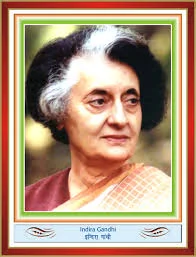
Indira Gandhi was a highly influential and contentious leader in modern Indian history. She became the first female Prime Minister of India and was instrumental in formulating Indian domestic and foreign policy. Renowned for being forceful and resolute, Indira Gandhi was a key political figure in India for almost 20 years.
Born in Allahabad (now Prayagraj) in Uttar Pradesh on 19 th November 1917, Indira Gandhi was the daughter of Jawaharlal Nehru, the first Indian Prime Minister. She was Prime Minister of India between 1966 and 1977, before returning for a second term in 1980, and was tragically assassinated on 31 st October 1984.
Throughout Indira Gandhi’s political career, a number of landmark events occurred in India, including the Green Revolution, nationalisation of banks, the 1971 Indo-Pakistani War, Bangladesh gaining independence and India’s first nuclear test in 1974. Yet, at the same time, Indira Gandhi’s government was heavily criticised, especially for instituting the ‘Emergency’ (1975-77). During this time, civil liberties were curtailed, and political dissidents were incarcerated.
Indira Gandhi therefore played an essential role in Indian history and is notable for both her successes and contentious actions.
Early Life
Indira Priyadarshini Nehru was born on 19 th November 1917 in Allahabad (British India) to Jawaharlal Nehru – a leading independence activist who eventually became the first Indian Prime Minister – and Kamala Nehru, who was also deeply involved in the Indian independence movement.
As a child, Indira was greatly influenced by India’s independence movement. Discussions and political activity often took place at her family house, Anand Bhavan, and this became a focal point for key independence figures.
Throughout her childhood, Indira was influenced by many key national figures, such as Mahatma Gandhi, Motilal Nehru and her father. Her father’s political involvement combined with her mother’s poor health meant that Indira’s early years were often dominated by both political and personal issues.
She was also an active young person and set up the Bal Charkha Sangh. Further, she organised the Vanar Sena, a youth group that backed the Indian National Congress in the independence movement.
These experiences helped to inspire her interest in both politics and society.
Education
Indira Gandhi was educated in both Indian and overseas schools. She attended schools in Pune, Mumbai, Switzerland and Bristol. She also studied at the University of Visva-Bharati in Santiniketan, which was set up by the famous author Rabindranath Tagore.
Later, Indira Gandhi was admitted to Somerville College, part of the University of Oxford, in England. Yet her studies were occasionally disrupted by personal and health-related issues.
Whilst she did not receive a formal degree, Indira maintained an interest in literature, history, international and political issues.
Her diverse educational background also enabled her to experience and learn from a wide range of global cultures. This in turn affected her views regarding world politics.
Marriage and Family
On 26 th March 1942, Indira Nehru married Feroze Gandhi. He was an Indian independence activist, as well as a journalist and politician who later became a Member of Parliament.
The couple had two sons;
Rajiv Gandhi, who later also became India’s Prime Minister.
Sanjay Gandhi, who rose to prominence during his mother’s time as Prime Minister.
Although the couple encountered marital issues and often lived apart, Indira was able to continue advancing her political career and at the same time care for her family.
Feroze Gandhi died on 8 th September 1960, due to a heart attack.
It should also be noted that Indira Gandhi was not related to Mahatma Gandhi. Her surname was adopted from her husband, Feroze Gandhi.
Entering Politics
As a child, Indira Gandhi was drawn further into Indian politics as a result of her father’s involvement in the independence movement.
Indira Gandhi became a member of the Indian National Congress in 1938. Throughout the independence movement, Indira was also politically active and was even arrested in September 1942 for her involvement in the Quit India Movement.
Once India had become independent in 1947, she was heavily involved in both political and administrative work alongside her father. Jawaharlal Nehru was the country’s first Prime Minister and Indira often travelled and engaged in international business with him.
Her political involvement progressively intensified.
In 1955 Indira Gandhi became a member of the Congress Working Committee. She then went on to become President of the Indian National Congress in 1959 and thus emerged as an important political figure.
On the death of Jawaharlal Nehru in May 1964, Indira Gandhi entered the Union Cabinet, under Prime Minister Lal Bahadur Shastri. She served as Minister of Information and Broadcasting.
When Shastri unexpectedly died in January 1966, Indira Gandhi was chosen as the Congress Party’s leader by the Congress parliamentary party.
Indira Gandhi – India’s First Female Prime Minister
On 24 th January 1966, Indira Gandhi became India’s third Prime Minister and the first female to occupy the most senior executive position in the country.
Many people at the time thought that as a woman Indira would be a less strong leader and would be susceptible to the influence of senior Congress Party members.
Nevertheless, Indira Gandhi progressively became her own strong political figure.
Her initial period as Prime Minister was difficult. There were issues relating to food supply, as well as economic and political concerns. Moreover, there were divisions within the Congress Party.
Nevertheless, Indira introduced various significant economic and political policies which had a substantial effect on India.
Key Achievements of Indira Gandhi
- Bank nationalisation
On 19 th July 1969, Indira Gandhi reformed the banking system by nationalising fourteen large commercial banks.
Previously, access to banking services was predominantly available in urban areas. As a result, it was not equally available to farmers, small businesses and less economically advantaged people.
The government contended that by nationalising banks, access to banking facilities could be widened and money could be utilised to further national development.
This therefore radically altered the Indian banking landscape and furthered the role of public sector banks in the Indian economy.
- Contribution to the Green Revolution
Throughout the 1960s, India struggled to produce enough food to satisfy its expanding population. Consequently, the nation heavily relied on food imports.
During her time as Prime Minister, the Indian government backed the Green Revolution.
This process involved implementing new, high-yielding seeds, improving irrigation, expanding fertiliser usage and developing agricultural research. In addition, the government provided back-up for farmers.
Prominent agricultural experts, such as M. S. Swaminathan, were instrumental in facilitating this revolution.
Overall, wheat and rice production was significantly boosted, especially in Punjab, Haryana and western Uttar Pradesh.
As a consequence, India moved towards improved self-sufficiency and accordingly decreased its reliance on food imports.
- Indo-Pakistani War of 1971 and Bangladesh’s independence
The Indo-Pakistani War of 1971 was one of the most significant events of Indira Gandhi’s political career.
It arose due to political dissent and military suppression in East Pakistan. This triggered an enormous refugee problem and millions fled across the border into India. Consequently, India had to deal with severe humanitarian, economic and security concerns.
Indira Gandhi’s government backed the Bangladeshi independence cause and managed the escalating international situation.
On 3 rd December 1971, India and Pakistan went to war.
Indian forces were highly successful, and East Pakistan’s Pakistani forces soon surrendered on 16 th December 1971.
Bangladesh subsequently became an independent nation.
India thereby greatly enhanced its international profile and Indira Gandhi solidified her image as a powerful political figure.
- ‘Garibi Hatao’
‘Remove Poverty’ was one of Indira Gandhi’s best-known political slogans.
Indeed, she heavily promoted this in the 1971 general election. She pledged to alleviate poverty, as well as tackle unemployment and economic disparity.
Her government introduced various schemes and implemented economic policies which sought to enhance the living standards of less well-off people.
Although poverty has continued to be a major concern in India, this campaign ensured that these issues were brought prominently into the political arena.
- Discontinuation of privy purses
Upon India’s independence, the previous monarchs of the princely states were granted ‘privy purses’ as part of the integration process between the princely states and the Indian Union. These represented financial benefits.
Whilst Indira Gandhi favoured the discontinuation of privy purses and the elimination of special treatment for former monarchs, the government first unsuccessfully attempted to do so via a presidential order in 1970. This was later ruled unlawful by the Supreme Court.
The government then successfully enacted the 26th Constitutional Amendment in 1971, which abolished privy purses and acknowledged the end of official preferential treatment for former princely states.
- India’s first nuclear test
On 18 th May 1974, India successfully carried out its first nuclear test at Pokhran in Rajasthan.
This was officially referred to as an atomic peaceful explosion and was named ‘Smiling Buddha’.
Such a test was a key development for India and illustrated the nation’s growing scientific knowledge. It also positioned India as a key international player in nuclear matters.
Nonetheless, the test provoked both global attention and criticism, mainly concerning nuclear proliferation and regional security concerns.
- Scientific and technological advancement
Whilst Indira Gandhi was Prime Minister, India continued to further its scientific and technological development.
Her government encouraged innovation in nuclear, space and industrial technologies, as well as scientific education.
Significant developments occurred in India’s space programme too. On 19 th April 1975, aided by the USSR, India successfully launched its first satellite, Aryabhata.
These were fundamental in building the foundations for future Indian space and technological success.
The Emergency (1975-77)
One of the most contentious aspects of Indira Gandhi’s political career was the imposition of the Emergency in June 1975.
On 12 th June 1975, the Allahabad High Court overturned Indira Gandhi’s election results in an election petition concerning alleged electoral malpractice in the 1971 Lok Sabha election. It therefore ruled that her election was invalid and that she was banned from holding elected office for six years (pending further legal proceedings).
Tensions heightened as opposition figures campaigned for Indira Gandhi to step down and protested against her government.
On 25 th June 1975, Indira Gandhi recommended to President Fakhruddin Ali Ahmed that a national emergency should be declared under Article 352 of the Indian Constitution, as there was internal disorder.
The Emergency officially started on 25/26 th June 1975 and lasted until 21 st March 1977.
During this time, a number of extreme policies were put into practice.
Key impacts of this period were:
- Limitation or suspension of key civil liberties.
- The arrest and incarceration of opposition and political figures.
- Strict controls over the press and media.
- Control over public demonstrations and political activity.
- Concentration of power in the central government.
- Implementation of controversial population control policies including forced sterilisation.
- Demolition of specific urban areas, especially in Delhi.
Many political figures, journalists and activists were all incarcerated during the Emergency.
The Emergency is amongst the most hotly discussed and criticised areas of Indian democratic history as it had a considerable impact on civil liberties, media freedom and opposition activity.
1977 General Election Defeat
Having been in power for just under 21 months under an Emergency, Indira Gandhi announced general elections in January 1977.
Elections were then held in March 1977. The Congress Party was comprehensively defeated.
Instead, the Janata Party – a combination of opposition parties – won the election and established a government headed by Morarji Desai.
Furthermore, Indira Gandhi was also defeated in her constituency for Rae Bareli in Uttar Pradesh.
Her election defeat emphasised the value of free and fair elections and governmental accountability.
For the first time since independence, a non-Congress Party was victorious at a national level.
Re-Entering Government in 1980
The Janata Party government was beset by internal strife and political instability following the 1977 election.
Morarji Desai resigned as Prime Minister in 1979, and the Charan Singh-led government was also unable to maintain power.
Indira Gandhi seized upon the unstable political environment and worked to re-energise her popularity.
The Congress (I) party obtained a landslide election victory in the January 1980 general election.
On 14 th January 1980, Indira Gandhi once again moved into the Prime Minister’s Office, thus re-entering government.
This was a highly significant political revival for Indira Gandhi following her 1977 election defeat.
Nevertheless, her second stint in government was also characterised by numerous serious problems, for example, political, regional and Punjab-related issues.
Operation Blue Star (1984)
Operation Blue Star is identified as one of the most sensitive and contested points of Indira Gandhi’s second period in government.
Throughout the early 1980s, Punjab became more politically unstable and saw increased militancy and calls for more autonomy. Furthermore, Jarnail Singh Bhindranwale and his armed associates had firmly entrenched themselves within the Golden Temple complex in Amritsar.
Tensions and violence further escalated.
In June 1984, Indira Gandhi’s government instructed the Indian Army to conduct Operation Blue Star to expel armed militants from the Golden Temple complex.
This military operation occurred between 1 st and 10 th June 1984.
Unfortunately, there was significant loss of life, including that of civilians, militants and Indian Army personnel. Also, the Akal Takht – one of Sikhism’s most important places of worship – was badly damaged.
Many within the Sikh community were profoundly upset by the army’s invasion of the holiest Sikh site.
Operation Blue Star is highly controversial and has had major ramifications for both Indian politics and inter-community relations.
Assassination of Indira Gandhi
On 31 st October 1984, Indira Gandhi was assassinated by her two Sikh bodyguards, Beant Singh and Satwant Singh.
This took place at her New Delhi residence.
It was widely believed that the assassination was in retribution for Operation Blue Star, which had occurred only a few months previously.
Following the shooting, Indira Gandhi was rushed to the All India Institute of Medical Sciences in New Delhi. Although medics endeavoured to save her life, she ultimately passed away as a result of her injuries.
Her assassination was a shocking event, not only for India but worldwide.
Across various regions of India, and particularly in Delhi, there was widespread anti-Sikh rioting in the aftermath of her assassination. Thousands of Sikhs were murdered, and many families had their homes and means of income destroyed.
This was one of the darkest periods in post-independent India. Debate and legal investigation continue to centre on the roles of political figures, governmental inefficiencies and the lack of protection for innocent people.
Shortly after Indira Gandhi’s assassination, her son Rajiv Gandhi was sworn in as India’s new Prime Minister.
Awards
Throughout her political career, Indira Gandhi received a variety of national and international accolades.
Notably, she was awarded:
- Bharat Ratna (1972) – India’s highest civilian honour for her contribution to the country.
- Mexican Academy Award (1972) – for her role in international issues and in Bangladesh’s independence movement.
- FAO’s 2 nd Annual Medal (1973) – in appreciation of her involvement in agricultural and food-related endeavours.
- Sahitya Vachaspati (1976) – presented by the Nagari Pracharini Sabha.
She was also internationally recognised for her political and diplomatic prowess.
Leadership Style
Indira Gandhi was renowned for her assertive and centralised leadership style.
She forged a strong personality and frequently took key decisions independently of senior party members.
Her leadership can be summarised as follows;
Strong political will – Indira Gandhi exhibited great political resolve, whether dealing with intra-party or national issues.
Centralised control – Whilst Indira Gandhi favoured central control of both government and political bodies, this was criticised as undermining the independence of these entities.
International relations – She adopted an independent foreign policy and was instrumental in maintaining India’s position in the Non-Aligned Movement throughout the Cold War.
National security – Indira was highly conscious of, and focused on, national security together with military preparedness, especially in relation to Pakistan.
Intervention in economy – Indira Gandhi’s government encouraged the development of the public sector and implemented the nationalisation of banks. It also promoted state involvement in key industries.
Historians, political scientists and policymakers continue to analyse and debate Indira Gandhi’s leadership style.
Interests
Alongside politics, Indira Gandhi was keenly interested in nature, the environment, books and culture.
She loved reading and travelling and was also passionate about preserving India’s natural heritage.
In addition, she supported environmental conservation and promoted awareness of wildlife preservation.
Her participation in both charitable and educational bodies highlighted her interest in contributing to society outside of governmental work.
Despite her busy political career, Indira Gandhi maintained good family links, especially with her sons.
Important Facts About Indira Gandhi
| Particular | Details |
|---|---|
| Full name | Indira Priyadarshini Gandhi |
| Birth name | Indira Priyadarshini Nehru |
| Date of birth | November 19, 1917 |
| Birthplace | Allahabad, British India |
| Father’s name | Jawaharlal Nehru |
| Mother’s name | Kamala Nehru |
| Husband | Feroze Gandhi |
| Children | Rajiv Gandhi and Sanjay Gandhi |
| Political party | Indian National Congress |
| Position | Prime Minister of India |
| First term | January 1966 – March 1977 |
| Second term | January 1980 – October 1984 |
| First woman Prime Minister | Yes |
| Bharat Ratna | 1972 |
| Major historical event | Bangladesh Liberation War, 1971 |
| Emergency | 1975–1977 |
| Date of death | October 31, 1984 |
| Place of death | New Delhi, India |
Legacy
Indira Gandhi’s legacy is multifaceted and still affects contemporary discourse on Indian politics, democracy, economic progression and national security.
She notably contributed to Indian agriculture, banking and science development. Moreover, her leadership during the 1971 Indo-Pakistani War and Bangladesh’s independence formation are amongst her most significant achievements.
Yet, her decision to institute the Emergency is also one of the main areas of criticism which has been levelled at her. The curtailment of civil liberties, incarceration of political dissidents and media censorship all prompted serious questions regarding the quality of democratic governance.
Operation Blue Star and the circumstances of Indira Gandhi’s assassination are also highly relevant and emotive aspects of more recent Indian history.
As an influential political figure, Indira Gandhi was pivotal to the direction of India at a time of considerable national and international change. Analysis of her achievements and contentious actions can yield valuable insights into facets of political leadership, as well as democratic structures and the duties of those in leadership positions.
Conclusion
Indira Gandhi is an important figure in post-independent Indian history. She was the first female Prime Minister and consequently helped to shatter a key gender-based barrier. During her career, she guided India through several complex and progressive times.
Her work in agriculture, banking, science and foreign relations all helped to mould modern India. The 1971 war, Bangladesh’s independence formation and 1974 nuclear test are all strongly associated with Indira Gandhi’s government.
However, to fully analyse Indira Gandhi’s political career, it is essential to consider the Emergency, Operation Blue Star and criticisms of her government.
Clearly, Indira Gandhi’s life demonstrates both the potential and perils of centralised power. Thus, her legacy is a blend of distinguished accomplishments, contentious decisions and areas of contention, and she is undoubtedly one of the most influential and discussed individuals in Indian political history.
References:
- Prime Minister of India. Indira Gandhi – Former Prime Minister of India. https://www.pmindia.gov.in/en/former_pm/smt-indira-gandhi/
- Parliament of India. Indira Gandhi – A Historical Tribute (December 1984). Read the Parliamentary Document (PDF)
- History. Indira Gandhi: Biography, Political Career and Legacy. https://www.history.com/articles/indira-gandhi
- UCLA Center for India and South Asia. Indira Gandhi – Independent India. https://southasia.ucla.edu/history-politics/independent-india/indira-gandhi/